
The Science
The science of reading a woman's body.
Grounded in decades of peer-reviewed research. Validated with our community — with clinical studies ahead.
A single number rarely tells the whole story.
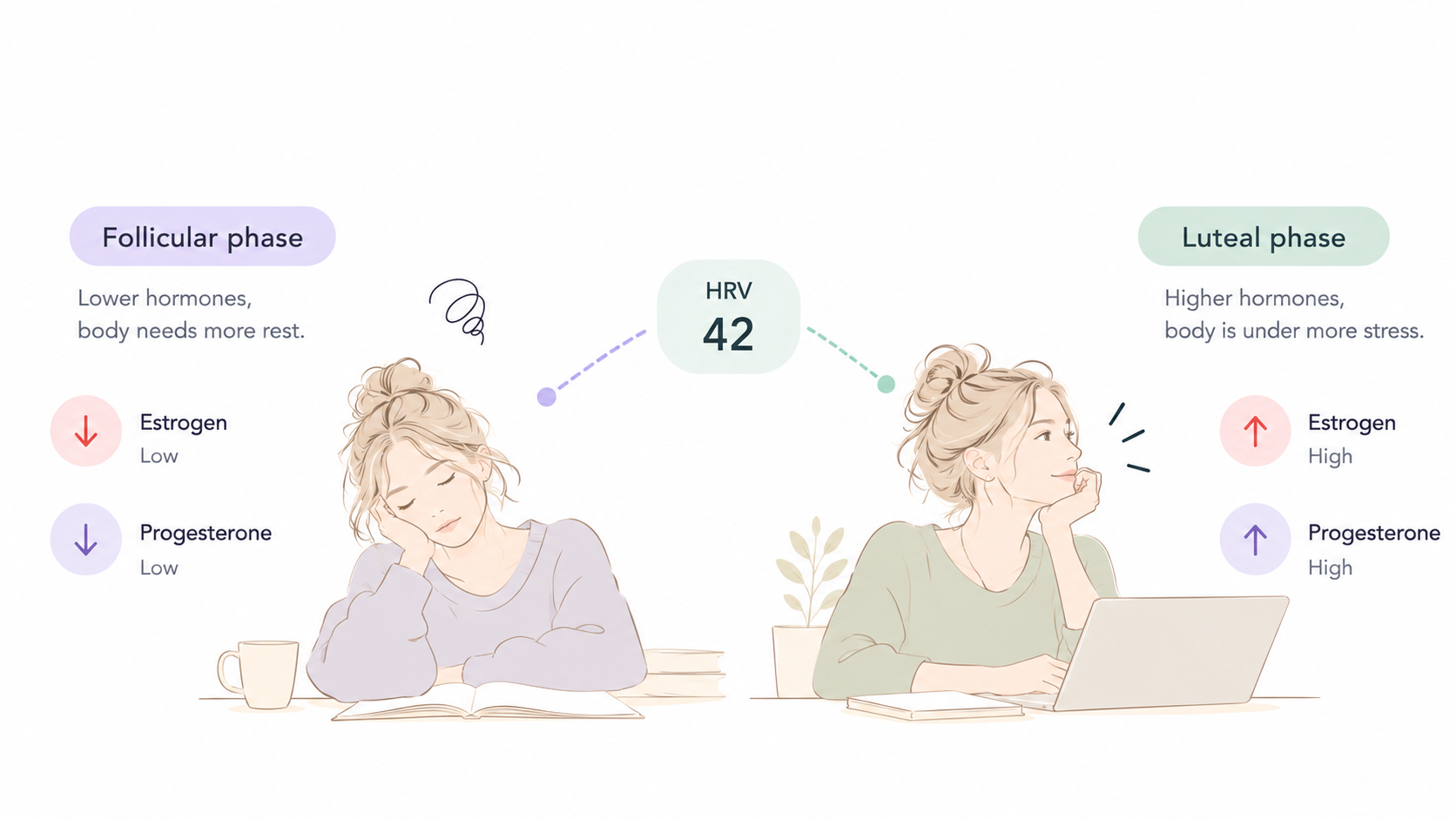
The same signal can mean opposite things, depending on where a woman is in her rhythms.
Most wearables read one number — your HRV, your temperature — and compare it to yesterday, or to a population average. But a woman's body doesn't run on a flat baseline. The same HRV reading can carry different context depending on where a woman is in her cycle. Read in isolation, a number can be incomplete — and sometimes misleading.
Three rhythms, working as one.
Her state on any given day isn't set by one clock. It's set by three — interacting.
Hormonal rhythm
The rise and fall of estrogen and progesterone.
Circadian rhythm
The body clock that governs sleep, energy, and recovery.
Stress rhythm
How the body responds to pressure — and how quickly it returns toward baseline.
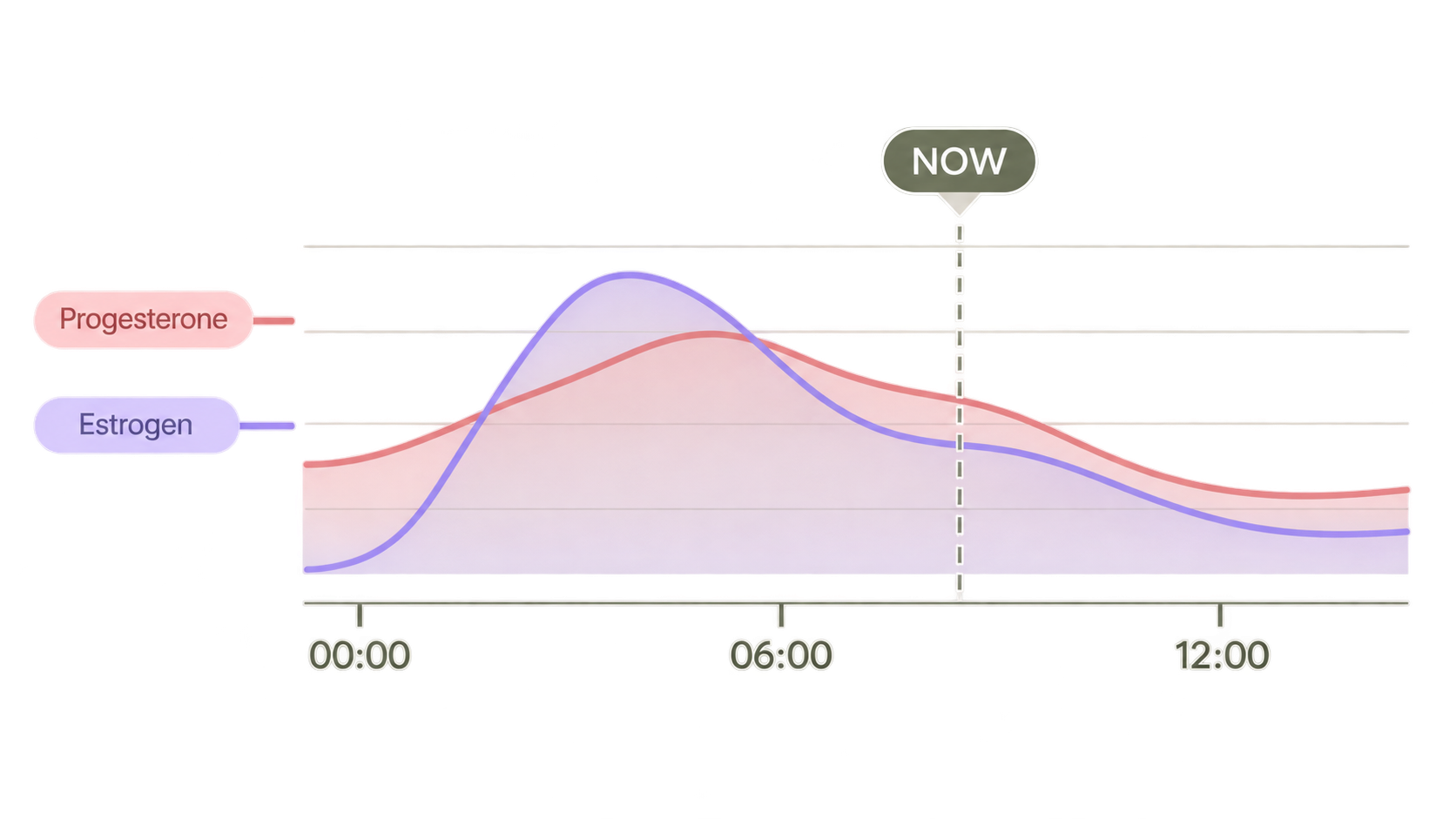
These three don't run in parallel — they constantly influence one another. Stress can disrupt hormonal patterns; disrupted circadian timing can affect sleep and recovery; hormonal shifts can change how you sleep.
The science of each rhythm on its own is well established. Reading all three together, as one interacting system, is the frontier — and it's the problem Rèsa was built to solve.
Women's physiology has historically been underrepresented.
For most of medical history, "the human body" meant the male body.
Many physiological models and reference ranges were developed without fully accounting for female-specific variation. When cycle-related changes are not modeled explicitly, meaningful within-person variation can be overlooked or misinterpreted.
Multi-rhythm signal interpretation.
One physiological data stream, interpreted through three interacting rhythms.
Rèsa does not evaluate any signal in isolation. From continuous physiological data, Rèsa models patterns associated with hormonal, circadian, and stress-related influences, estimates how those influences may contribute to the current state, and examines how they interact. The method rests on three principles.
Relative trends, not absolute values.
We estimate the direction and phase of each rhythm from peripheral signals such as skin temperature and heart rate variability. We do not measure circulating hormone levels.
Individual baselines, not population norms.
Each reading is compared against a continuously updated personal baseline, rather than a population mean, to account for wide inter-individual variation.
Physiological and self-reported data, combined.
Sensor data is paired with daily self-reports, so the model learns how measured change relates to perceived state for each user.
Validation methodology.
We are conducting validation across two complementary layers: laboratory reference and longitudinal real-world data.
Signal-level accuracy
We are conducting a study benchmarking our hormonal-trend estimates against urinary hormone metabolite testing, an established reference method in menstrual-cycle research.
System-level interpretation
Interactions between rhythms cannot be assessed in a single lab session. We are conducting a longitudinal study that pairs continuous sensor data with daily self-reports from a 1,200-participant community cohort, observed across multiple cycles.
Rèsa is a general wellness product, not a medical device. It is not intended to diagnose, treat, or prevent any disease, and does not replace medical testing or clinical care.
Help build the science.
Every woman who joins helps close a 30-year gap